Hit enter to search or ESC to close
In the current landscape of commercial construction, volatility in raw material costs has made determining a precise 1 5 8 metal stud price a complex challenge for procurement managers and contractors. As steel prices fluctuate and global supply chains stabilize, the industry is shifting toward a more technical evaluation of value, moving beyond the lowest unit price to consider total landed costs and lifecycle durability.
The discrepancy in pricing often stems from variations in galvanization grades, roll-forming tolerances, and the presence of intermediary markups. When specifications are loosely defined, buyers risk procuring materials that meet a price point but fail in high-humidity environments or cause installation delays due to dimensional mismatches, ultimately eroding the project's profit margin.
This analysis explores the technical drivers of pricing in light steel framing and ceiling support systems. By examining the relationship between material specifications and factory-direct sourcing, we provide a framework for evaluating 1 5 8 metal stud price to ensure structural integrity and cost-efficiency.


The final price of light steel framing is not merely a reflection of the raw steel coil weight. It is a composite of raw material procurement, the energy cost of precision roll-forming, and the chemical application of protective coatings. Vertical integration—where a manufacturer controls everything from coil sourcing to final packaging—typically removes the 20-35% markup associated with trading companies.
Furthermore, the efficiency of the production line directly impacts the waste ratio. Advanced automated lines, such as those utilized by Wen'an Jinkai Building Materials, reduce scrap rates and ensure that the cost is driven by engineering precision rather than operational inefficiency.
Steel thickness is the primary driver of structural load capacity and cost. Even a variation of 0.05mm in the base material can significantly alter the total tonnage of a project, thereby shifting the budget. Buyers must verify whether the quoted price refers to the nominal thickness or the actual delivered thickness to avoid structural deficiencies.
Galvanization levels, such as G40, G60, or G90, create distinct pricing tiers. Higher zinc coatings provide superior corrosion resistance, particularly in coastal or high-humidity environments, but increase the initial procurement cost. A lower initial price for a G40 coating may lead to premature rust bleed, increasing maintenance costs threefold over five years.
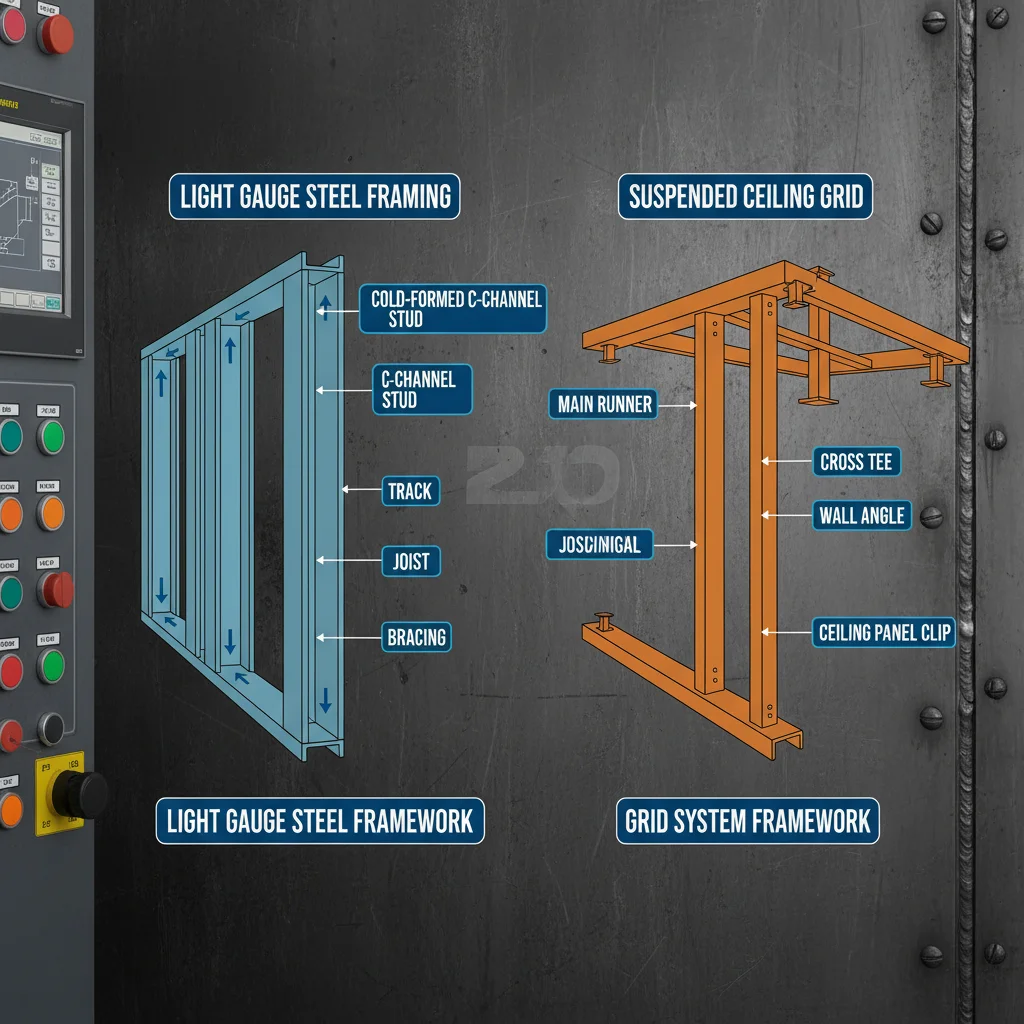
Tolerance standards, such as the Japanese Industrial Standards (JIS), ensure that components like cross-tees and main runners snap together without on-site trimming. When a supplier adheres to JIS tolerances, the reduction in installation labor hours often offsets a slightly higher material price, lowering the overall project cost.
Selecting a coating based solely on the lowest unit price is a common procurement error. In humid climates, the interaction between the zinc layer and the atmospheric moisture can lead to "white rust" if the coating is insufficient.
For high-spec commercial interiors, the use of clear sealers or custom RAL powder coatings adds a premium to the cost but prevents chipping during the snap-fit installation process. This ensures a seamless finish that meets the rigorous standards of premium retail and hospital environments.
The impact of manufacturing precision on installation efficiency is quantifiable. Components produced with loose tolerances often require manual adjustment, which slows down the assembly of the grid system and increases the risk of cross-tee disengagement.
By comparing standard roll-forming outputs with JIS-calibrated precision lines, we can observe a marked difference in fitment reliability. This reliability is critical for seismic-rated installations where positive-locking connections are mandatory.
The application environment dictates whether a project should prioritize material volume or weight optimization. In industrial cleanrooms or hospitals, FUT Grids with 0.50mm steel and G90 galvanization are recommended to handle higher dynamic loads and rigorous sanitation protocols. These configurations command a higher price but prevent structural sagging over long spans.
Conversely, in minimalist retail spaces or standard office renovations, Ultra Lined (Silhouette) profiles offer a cost-effective alternative. These designs reduce raw steel usage while maintaining the required load ratings, effectively lowering the landed cost without compromising the aesthetic plane of the ceiling.
The construction industry is increasingly pressured by LEED and BREEAM certifications to reduce the embodied carbon of materials. This is driving a shift toward "Ultra-Light" grid designs that utilize high-strength alloys to maintain structural performance while reducing total steel weight per linear foot.
Another emerging trend is the integration of thermally optimized profiles. Research indicates that optimizing slot perforations in steel webs can reduce thermal conductivity, improving the overall energy performance of the ceiling assembly. This evolution transforms a simple support component into an active part of the building's thermal envelope.
Ultimately, the focus of the market is shifting from "lowest price per piece" to "lowest carbon footprint per square foot." Manufacturers who can prove both technical precision and material efficiency will likely dominate the procurement cycles of the next decade.
When comparing quotes, procurement officers should use a weighted matrix that balances the initial 1 5 8 metal stud price against installation speed and durability. A quote that appears 10% lower but lacks JIS tolerances may actually increase the total project cost by 15% due to labor overruns.
Verification of certificates (such as ISO 9001:2008) and third-party inspection reports is essential to ensure that the stated specifications are consistently met across all shipping containers. Factory-direct sourcing is the most reliable way to ensure this traceability.
The following matrix provides a framework for selecting the appropriate configuration based on typical engineering requirements and environmental constraints.
| Configuration Type | Coating Specification | Steel Thickness | Recommended Use Case |
|---|---|---|---|
| Basic Profile | G40 Galvanized | 0.30mm | Internal dry partitions |
| Standard Grade | G60 Galvanized | 0.35mm | Standard office ceilings |
| High-Duty Profile | G90 + Pre-painted | 0.45mm | Coastal / High-humidity |
| Precision Grid | JIS Tolerance G90 | 0.40mm | High-end commercial |
| Seismic-Rated | G90 + FUT Locking | 0.50mm | Hospitals / Schools |
| Eco-Light | Low-Zinc / High-Strength | 0.30mm | LEED certified projects |
While a higher grade like G90 increases the initial unit price, it significantly lowers the lifecycle cost. In coastal areas, G40 or G60 coatings often fail within 12-24 months, leading to rust streaks on the ceiling tiles. Replacing the grid and the damaged tiles usually costs three times more than the initial premium paid for a G90 coating, making it the more economical choice for humid environments.
JIS (Japanese Industrial Standards) tolerances ensure that every piece of the grid—from the main runner to the cross-tee—fits with extreme precision. In large-scale projects, a deviation of just 0.5mm can lead to gaps or "buckling" across a 50,000 sq ft ceiling. Using JIS-standard roll-forming eliminates the need for on-site trimming and reduces the risk of cross-tee disengagement, accelerating installation speed by up to 20%.
Buyers should request a coating thickness test report and a tensile test certificate from the manufacturer. A reputable factory will provide digital micrometer measurements for every production batch. If a supplier cannot provide these reports, there is a high risk that the "nominal" thickness is being used to lower the price while delivering a thinner, structurally inferior product.
FUT grids typically carry a higher price due to the positive-locking tab design and the more rigorous roll-forming process required to achieve the lock. However, for seismic-rated projects or areas with high vibration, they are essential. They remove human error from the installation process, ensuring that the connection remains secure even if the workforce is rushed, thus preventing costly safety callbacks.
Direct-factory sourcing eliminates intermediary trading markups, which typically range from 20% to 35%. Beyond the unit price, manufacturers like Wen'an Jinkai optimize export packaging with VCI anti-corrosion film and heavy-duty cartons to keep shipping damage rates below 0.3%. This reduces the need for unplanned re-orders and prevents project delays, significantly lowering the actual landed cost per project.
For standard lengths (e.g., 3.05m or 3.6m), pricing is optimized for mass production. Custom lengths between 300mm and 4,000mm can be produced via OEM/ODM customization. While there may be a slight premium for small custom batches due to setup times on the roll-forming line, these costs are often offset by the reduction in on-site waste and labor spent cutting standard lengths to fit.
Analyzing the 1 5 8 metal stud price reveals that the lowest initial quote is rarely the most cost-effective solution. The true value of a steel framing system is found at the intersection of JIS-standard precision, optimal galvanization for the environment, and the removal of intermediary markups through factory-direct procurement.
For procurement managers, the shift should be toward a "Total Cost of Ownership" model—where structural reliability and installation efficiency are weighted as heavily as the raw material cost. By partnering with integrated manufacturers specializing in 1 5 8 metal stud price optimization, contractors can ensure project profitability without compromising on engineering standards.